Wednesday, June 25, 2014

Paul V. Kane's Recent Commentary / Cardinal George

http://www.newsday.com/opinion/oped/three-bold-moves-catholic-church-needs-paul-kane-1.7899028

In a recent widely-publicized commentary, Paul V. Kane describes Pope Francis as  "a rare man and gifted leader who lives the message of Jesus...and as one who seeks to convert the church..."  He goes on to suggest three needed reforms with which I agree:

        1) Dropping from 75 to 70 the mandatory retirements age for bishops and cardinals.
        2) Ending the celibacy requirement.
        3) Establishing a parish leadership council composed of lay women and men and eliminating the parish leadership model that "is built around an all-powerful pastor."

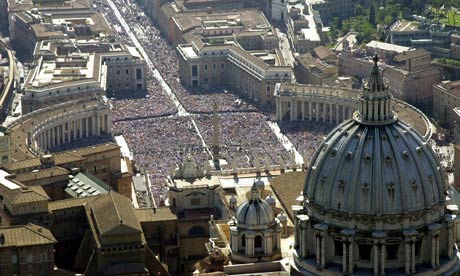
Pope Francis celebrates a Mass in St. Peter's

His stated reason for dropping the mandatory age retirement is that, in the past, "church officials have found it more important to promote men into leadership positions whose orthodoxy and embrace of traditionalism were never questioned."  Many, he states, "were possessed by a severe theology that saw the church under siege in a hostile world."  Consequently, the age and inflexible leadership models came at an "enormous expense...It denied the advancement of sounder, more dynamic leaders willing to move in new directions..."  This, according to Kane, resulted in a massive exodus of good people from the church and "accompanied a wave of horrific child sex abuse scandals."  Kane applauded Pope Francis for publicly asking forgiveness for the scandal.

Kane pointed out that during the Church's first thousand years of priests, there was no rule baring their service due to marriage.  According to Kane, "the rule of celibacy arose mainly for human, not divine reasons" because "the motivation for keeping priests unmarried came as some bequeathed church land to their sons."  This prompted church decision makers to institute measures to protect church property.

Kane proposed that a papal commission be established, made up of lay Catholics and clergy to end the celibacy requirement.  He named two individuals he thought would make "ideal co-chairs of such a commission -- Archbishop Sean  O'Malley of Boston and Mary McAleese, wife, mother, canon lawyer and former president if Ireland."

Moving on . . .

It appears that Cardinal George's health has caused church leaders to seriously begin vetting candidates to replace him.  Gossipy news media personalities continue to publicize names they  project to be on the "short list."  Archbishop Wilton Gregory's name continues to be named by these media personalities.  THE CONTINUED SURFACING OF PEDOPHILE COMPLAINTS AND THE RESULTING PAY-OUTS FROM DIOCESAN COFFERS prompt me to question whether I should wish such a appointment on a cleric I admire and respect.  Nevertheless, without a doubt, Archbishop Gregory status is deserving of being elevated to the level of cardinal.


Recently, more lawsuits have been filed against the diocese in relation to former priest and convicted sex offender, Daniel McCormack.  His offenses took place under Cardinal George's watch.  As of March 2014 it has been reported that up to $2.1 million was paid an abuse victim.

Cardinal George has indicated his wish to have input in the vetting process.  Due to his weakened condition, his recent meeting with SNAP (Survivors Network of those abused by Priests) leaders was taped in the event his health does not permit him to testify in court.  Another such taping is scheduled for the future.

Monday, April 14, 2014

Replacing Chicago's Cardinal George

Recently, the names of two archbishops who were speculated to be on the short list of candidates to replace Chicago's Francis Cardinal George, are currently dealing with leadership issues in their respective diocese.

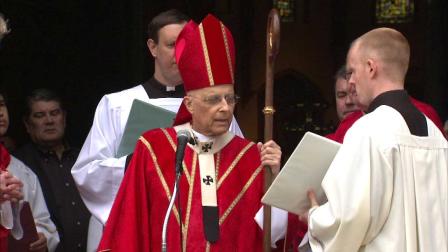
Cardinal Francis George presided over the blessing of the palms before mass at Holy Name Cathedral Sunday morning.

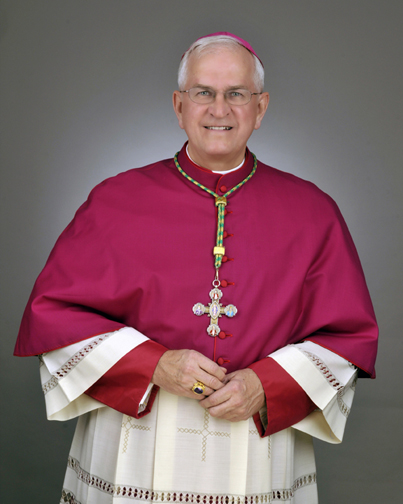
Employees in some of Seattle's Catholic dioceses are experiencing credit card fraud.  Their social security numbers have been usurped and they have been billed for purchases they never ordered.  Archbishop Wilton D. Gregory of Atlanta, Georgia has been criticized for building and moving into a $2.2 million dollar residence.  The situations in both dioceses have placed the archbishops in compromising positions.  Speculators have now added to the list the name of Archbishop Joseph Kurtz of Louisville, Kentucky.


Francis Cardinal George's cancer has recurred and he is undergoing aggressive chemotherapy.  It is questionable about how much longer he can effectively fulfill his diocesan duties.  He had hoped to travel to Rome for the canonization of Pope John Paul II and Pope John XXIII.  However, due to his health, he has followed his doctor's recommendation not to travel to Rome. 

He is quoted in Saturday's (4/12/14) issue of the Chicago Sun-Times as stating that the official process to replace him has not yet been launched, but that he has urged Catholic officials to start it.  He is further quoted as remarking, "the fact that my health is uncertain...it's just not fair to the archdiocese to have someone who may not be able to do the job as well as I believe it should be done...I'm not going to be dying I don't think in the next few months..."  He said, "Hopefully, the chemo will not only slow the cancer down, it will shrink whatever tumors are there and contain it."  He said that once his successor is chosen, he hopes to meet with him "to be able to be of service if he wants it...Inevitably after 17 years...I know a lot of people, and if he wants to ask questions, I will be available for service." 

Although Archbishop Sartain is in no way involved in the credit card scam in his diocese. It is having a devastating financial impact on employees in his diocese.  However, it is occurring on his "watch."  I understand that his is "pulling out all stops" to correct the situation.

On March 31, 2014, conservative Fox News Associated Press posted an article about Atlanta's Archbishop Gregory's purchase of a $2.2 million mansion.  There was speculation in the article that the purchase of the property was part of a real estate deal made possible by money by Joseph Mitchell 's estate.  Joseph Mitchell is said to be the nephew of Margaret Mitchell, author of "Gone With the Wind," a Civil War epic that made his family wealthy.  When Mitchell died in 2011, according to the article, he left to the archdiocese as estate valued at more than $15 million on condition that it be used for "general religious and charitable purposes." 

Millions spent on Catholic clergy anger parishioners photo 

It was reported that Archbishop Gregory's intent in purchasing the $2.2 million property was to design a home with large meeting spaces and rooms for receptions and gatherings.  It was reported that cathedral officials were planning to expand the Archbishop's old home where its priests could live while freeing up space on the cathedral's cramped campus.  The Fox article listed tax record as one of its sources.

Archbishop Gregory responded immediately to the criticism, taking full responsibility for the purchase of the property.  According to an April 5, 2014 press release, Archbishop Gregory convened a meeting at the Chancery with three archdiocesan consultative groups to seek their counsel.  Following the meeting, Archbishop Gregory was quoted as saying, "After consultation with members who were available to attend, from the Archdiocesan Pastoral Council, Archdiocesan Finance Council and the Council of Priests, and hundreds of well-meaning parishioners of differing points of view -- some who sent written observations -- as well as my own personal reflections and prayers, I have decided to sell the Habersham property and invest the proceeds from the sale into the needs of the Catholic community."

Archbishop Gregory's reported plan is to vacate the residence in May and to move to another archdiocesan property, not his previous residence.   

Archbishop Gregory's forthrightness, his humility and his impeccable record of leadership, definitely  make him worthy of being elevated to the level of Cardinal.  

Wednesday, March 26, 2014

Replacing Chicago's Cardinal George


Now that Chicago's Cardinal George's cancer has recurred, it is just a matter of time when his replacement will be announced.  Grapevine predictors have stated that a short list of candidates are being vetted.  Of course, church officials have been mum regarding speculations. 


Two speculated to be on the short list are Archbishop J. Peter Sartain of Settle and Archbishop Wilton D. Gregory of Atlanta.  One "plus" regarding Archbishop Sartain is that he was formerly bishop of Joliet.  

There can be no legitimate comparison between Archbishop Sartain and Archbishop Gregory.  Archbishop Gregory's roots as those of Cardinal George are in Chicago, both being born in Chicago.  Archbishop Gregory was not only born in Chicago, was educated in Chicago and received his priestly preparation in Chicago.  


He attended Chicago's St. Carthage Elementary School, Quigley Preparatory Seminary and St. Mary of the Lake Seminary.  He later earned his doctorate of Sacred Liturgy at the Ponifical Liturgical Institute in Rome.  He served at vice-chair and later chair of the National Conference of Bishops and is noted to being a very effective leader as Archbishop of Atlanta.

During the vetting process, I understand that candidates are given the option of making a decision not to be considered for the position.  I question who would turn down such an offer.

Thursday, February 20, 2014

Where are the African-American cardinals?


The National Catholic Reporter recently assigned Hiedi Schlumpf to interviewed me and subsequently published the following article first in their Jan 31-Feb 13 weekend print edition and now on their web site:

http://ncronline.org/news/people/where-are-african-american-cardinals

Note: There were a few points I wanted to address:

1. I spoke of St. Xavier's having three African Americans in the Nursing Program, but I did not tell her that I was one of the three.
2. I told the interviewer that I was one of seven African Americans in the Liberal Arts Program and that the other six dropped out for various reasons and that I was the lone one to graduate.
3. I mentioned that I was a long-time member of Corpus Christi Church, but that it was at Holy Cross Church where my siblings and I were made to sit at the back of the church.

On the whole, the article was well-written and I am pleased with the overall effect which is to serve the purpose of focusing attention on the lack of African American cardinals.

Thank you, Hiedi Schlumpf & the National Catholic Reporter.


Here is the text of the article:

Where are the African-American cardinals?


 |  
COLUMN


When Pope Francis named 19 new cardinals Jan. 12, many Catholics cheered what seemed to be an emphasis on diversity, with half of the red hats going to bishops from non-European countries, including parts of the developing world.
But Dolores Foster Williams of Chicago was not exactly pleased.
"I didn't note any African-Americans on the list," said the 84-year-old Williams, who has made eradicating racism in the church her life's work.
A retired teacher and the author of Institutional Racism in the Catholic Church, Williams sees the lack of an African-American cardinal as the "undeniable tip of the church racism iceberg."
"The cardinals are the ones who elect the pope, so we have no representation there. Why aren't we at the table?" The answer, she says, is blatant racism and nepotism.
Preview theReligious Lifesection from our Feb. 14-27 edition.
"Caucasian priests who became cardinals were trained either in Diocesan seminaries or Order seminaries, and their upward progressions appear to have been fostered by influential individuals within those domains," Williams wrote on her blog in September.
And the elevation of African cardinals, while important, doesn't count, she says: "Africans and African-Americans are culturally different."
Williams spoke with NCR in December and again this week after the announcement of the new cardinals. With an apron around her waist and a gold cross around her neck, she welcomed me into her South Side of Chicago home, tastefully decorated with African art, and shared her own experiences of racism in the church.
"I'm not looking to make a name for myself," she said. "I'm not interested in being a spokesman for anything, but I feel it should be known. Something should be done."
In her book, Williams details the church's history of institutional racism, from the segregation of the past to the even more insidious, de facto segregated church attendance of today. That, combined with an unjust decline in support for struggling African-American congregations and schools, has led to the closing of black parishes all over the country, she says.
Williams' own parish, Corpus Christi in Chicago's Bronzeville neighborhood, is struggling for its survival. She grew up in the parish but remembers African-Americans having to sit in the back of another church. After her parents divorced, she and her siblings spent some time at a Catholic home for children where, as the first African-Americans there, they once again were segregated at a separate dining table.
She had a more positive experience at St. Benedict the Moor, an all-black boarding school in Milwaukee, although she said that institution, too, had a history of racism. Still, Williams recalls the white nuns who taught there as "never doubting our ability to learn."
When she entered the liberal arts program at St. Xavier College in Chicago, Williams was one of three African-American students. The two others left, leaving Williams to graduate in 1951 as the first African-American in the program. She went on to earn a master's degree in education from Loyola University.
She and her husband moved into the Chatham neighborhood in the 1950s, when it was still predominantly white, and joined the solidly Irish St. Dorothy Parish. Outspoken about what she saw as issues in the school, Williams says she didn't fit in.
"I know there was a difference in the way they reacted to African-Americans versus Caucasians," she says. "I saw it as racial."
After a 36-year career in education with Chicago Public Schools, Williams completed the archdiocesan lay ministry program and has been involved in the National Black Catholic Congress. She also has written a history of St. Benedict the Moor School.
She tirelessly and energetically continues to speak out about her dream of an African-American cardinal, engaging anyone who will listen.
A recent letter to Cardinal Francis George of Chicago resulted in a response accompanied by a copy of his letter to parishes about racism. "Just a letter in a bulletin doesn't do it, as far as I'm concerned," Williams said.
Yet she is hopeful that Pope Francis, who has already shaken up the church with his open style and emphasis on justice, will turn his attention to what Williams calls "a sin in one sense more grievous than the priest abuse scandal, because more individuals have been affected."
With Cardinal George set to retire, Williams is campaigning for Bishop Wilton Gregory of Atlanta, an African-American Chicago native who served as president of the bishops' conference. "Of all the bishops I know, he would be the best one," she says. "He would be perfect."
[Heidi Schlumpf teaches communication at Aurora University outside Chicago.]
This story appeared in the Jan 31-Feb 13, 2014 print issue under the headline: Where are the African-American cardinals? 

Friday, December 20, 2013

Cardinal Francis George's 50-Year Anniversary Gala

12-20-13

I watched news clips today of the celebration marking Chicago's Cardinal Francis George's 50th anniversary as a priest. 

Cardinal Francis George gives the homily during Mass at the tomb of St. Peter.


During the mass, as he faced the congregation at Holy Name Cathedral, I noted the array of cardinals that were seated behind him in semicircles. I understand that they came from all over. I noted that they were all white. If there were Latinos in the group, they were white Latinos.  Not one dark face. Even though there are African cardinals they were not on the altar behind Cardinal George.

After Mass, the celebration was continued at Chicago's exclusive Drake Hotel. The finery was well displayed by the TV shots. This pomp and circumstance has not been promoted by Pope Francis. 


Cardinal George has reached the mandatory retire age (75). I understand that his date of retirement is near. One TV station commentator named three serious candidates. One of them is Archbishop Wilton Gregory of Atlanta. 

Archbishop Wilton D. Gregory

Racism and sexism remain stains on the souls of the white male-dominated Roman Catholic hierarchy. African American bishops/archbishops continue to be locked out of membership in the lofty “College of Cardinals” even though there are many who should be members.

Archbishop Wilton D. Gregory of Atlanta, Georgia is a prime example of an African American who should be a member of that group of “princes of the Roman Catholic Church.” Archbishop Gregory was converted to Roman Catholic Catholicism while attending Chicago’s St. Carthage Grammar School. One would think that his impeccable credentials are reasons for him to have been inducted into the College of Cardinals many years ago. 

He was vice president and later president of the U.S. Catholic Bishop’s Conference and under his leadership the Catholic bishops implemented the “Charter for the Protection of Children and Young People.” He has authored several books and is the recipient of numerous awards. The admiration he received from non-Catholics is evidenced by the fact that he was inducted into the Martin Luther King Board of Preachers at Morehouse College in Atlanta.

If, by any chance, African Americans were nominated to be inducted as cardinals, it behooves the Catholic hierarchy to make known such an effort. If no such nominations were made, it behooves the Catholic hierarchy to explain why African Americans are not in the College of Cardinals. 


If Gregory is not elevated to the position of cardinal, it will say a lot about the state of the Roman Catholic Church. Since Archbishop Gregory distinguished himself as a Chicago priest and a bishop in a diocese in Illinois, he is a natural for the position.

Tuesday, October 15, 2013

Tea Party Politics - Playing the Race Card


After centuries of the papacy's ostentation, greed, mismanagement and corruption God has sent a craftsman in the person of Pope Francis to repair the broken arm of the chair of St. Peter. Pope Francis, to date, has opened the doors and windows of the papacy in his focus on the poor and marginalized people of God who need help. Hopefully, the appointments he has made and will make will prove to be fruitful. The pageantry, pomp and circumstance that have characterized the Vatican persona of the past appear to be rituals of the past. 


I hope and pray that the glaring ecclesiastical leadership flaws in the United States will reach the attention of Pope Francis. The lack of African American cardinals is a void that emanates from local levels in the United States.  There needs to be a serious examination of the process that has enabled the various ethnic priests to ascend to the level of cardinal and the conscious or unconscious manipulations that have contributed to the exclusion of African Americans. 

I mailed to Pope Francis a copy of my book, INSTITUTIONAL RACISM AND THE CATHOLIC CHURCH, TURNING FROM A TROUBLED PAST TO A MORE INCLUSIVE FUTURE. In the cover letter I implored the Pope to use the influence of his office to address the racial injustices that permeate the Roman Catholic Church within the United States. It is questionable as to whether the package will ever reach Pope Francis, but I feel good about having made an effort to have my voice heard.

Institutional Racism and the Catholic Church

Another area of immorality and injustice that the Roman Catholic hierarchy in the United States needs to address is the blatant disregard by so-called Tea Party groups to demean the presidency of Barack Obama. These groups have demonstrated a determination to dismantle the United States government in order to muddy President Obama's presidency. President Obama and First Lady Michelle Obama have borne the brunt of racist characterizations that have received much media attention. Civil Rights icon, John Lewis, was spit upon by individuals within a Tea Party protest group that was in the Capital.


These discriminatory acts are not just private emotional and personal sentiments, they are a system of an immoral force that violates and nullifies tents incorporated in the Ten Commandments. I would project that if a poll was taken among Tea Party members it would reveal that they profess to be Christians with a sizable number being of the Roman Catholic faith. Hopefully, level heads within the government will prevail and make the United States the "more perfect union" it was meant to be.


Saturday, October 12, 2013

The Catholic Church has Wide-Reaching Influences


Since writing my book Institutional Racism and the Catholic Church, I've been reaching out to the Catholic press to publish articles, and to date no one will accept a feature article. My requests for interviews have also not been responded to. Recently, a significant Catholic magazine first agreed to place an ad for my book in their online publication, then rescinded that approval. Here was the ad graphic:


Although the Catholic Church has wide-reaching influences, I am hopeful that some agency/group/influential individual will become aware of my book and respond regardless of the title.  Bottom-up Catholics are afraid to openly criticize the church, and the hierarchy, fearful of losing influence, has been successful intimidating its underlings. 

A case in point is Father Bryan N. Massingale, the author of RACIAL JUSTICE and the CATHOLIC CHURCH.  If you recall, I used him as a source in the racism book.  He is in "left field" all by himself.  When I have mentioned his name in conversation with Catholics, lay and religious, they raise their eyebrows and clam up.  He is an associate professor at Marquette University and from all appearances, he is respected by his predominately white students.  I suspect that his salary is augmented by his numerous speaking engagements that are not well publicized.